
When to Schedule Service for Your Illuminated Signs in Holland, MI
A clear maintenance and troubleshooting guide for Holland, Michigan businesses with illuminated signs, including warning signs, weather impacts, routine checks and professional repairs by D-Sign LLC.
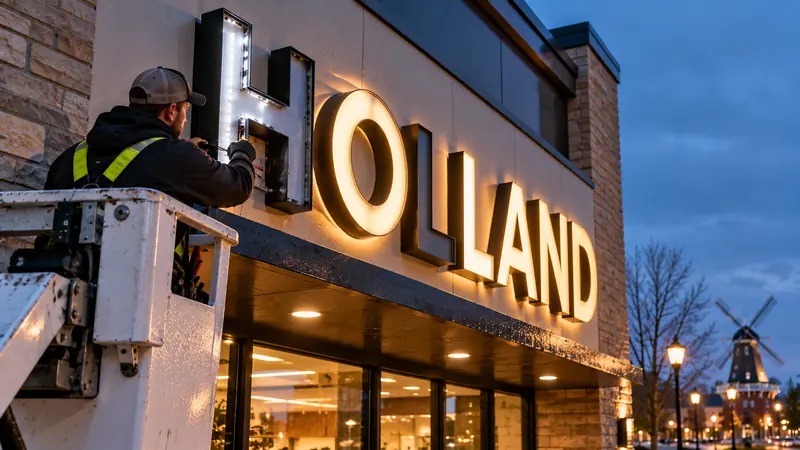
Schedule service when you see persistent flicker, dark sections, dim or uneven light, visible wiring damage, water inside the cabinet, or when illumination becomes noticeably discolored. Those problems indicate either simple maintenance is due or that an electrical or structural repair by a qualified technician is required.
Delaying service often increases repair scope and cost and can create safety hazards. Addressing issues early reduces downtime and keeps your storefront presentable.
What warning signs mean my illuminated sign needs inspection or service?
The clearest warning signs are visible and measurable problems you can spot without tools.
- Flickering. A sign that flickers instead of producing steady light usually indicates a failing power supply, loose wiring or failing LEDs and should be checked rather than ignored.
- Sections that no longer illuminate. If one or more segments of channel letters or cabinet faces are dark, the issue can be as simple as a loose connector or as serious as a failed LED module or damaged driver.
- Inconsistent brightness or dim LEDs. When parts of a sign are noticeably dimmer, the lighting system may be losing lumen output over time, which can be due to failing components or moisture entering the fixture.
- Intermittent operation. If your sign turns off and on unpredictably, that intermittent behavior points to electrical problems that need a qualified diagnosis.
- Visible wiring issues or scorch marks. Any exposed or frayed wiring, melted insulation or burn marks is an electrical hazard and must be evaluated by a trained professional immediately.
- Water intrusion and condensation. Moisture inside an illuminated cabinet, beads of water, or fogging on the lens can corrode components and accelerate failures.
- Damaged faces or mounting hardware. Cracked acrylic, broken trims, bent returns, or failing fasteners can allow weather into the sign and affect both appearance and function.
- Unusual discoloration or uneven illumination. If tones shift from the original color or light appears blotchy, internal components or the face material may be degrading and need service.
Documenting these observations with photos and timestamps helps a technician diagnose intermittent problems that might not be present during an inspection.
What types of illuminated signs are common and how do their problems differ?
Channel letters, internally illuminated cabinet signs and other LED signage each have distinct failure modes and inspection points.
- Channel letters. These contain individual LED modules and drivers; problems often show as single dark letters, loose faces, or damaged returns that admit moisture.
- Internally illuminated cabinet signs. These rely on an internal array of LEDs behind a face; common issues include uneven light, water pooling, and face damage that affects diffusion.
- LED electronic message centers. These have many individual pixels and drivers; failing modules, control issues, or door seals letting in moisture are typical concerns.
- Other LED signage. Routed signs with backlighting, dimensional signs, and custom illuminated elements can have unique mounting or component access points that need inspection during service.
Knowing the specific construction and access points for each sign type speeds diagnosis and helps prioritize repairs.
How does West Michigan weather affect illuminated signs?
West Michigan weather exposes signs to rain, snow, ice, wind and repeated freeze and thaw cycles and that exposure speeds wear on faces, seals and electrical components.
Holland and the surrounding area receive substantial precipitation and seasonal cold that matter for outdoor fixtures: the area’s average annual precipitation is about 33 inches according to state climate data, and the mean annual air temperature is 48.6 degrees Fahrenheit, both of which influence moisture and thermal cycling on signs (PROGRESS REPORT NUMBER TWENTY).
Annual snowfall in the Holland area is comparable to Grand Rapids, which averages about 56.4 inches of snow per year, and snow and ice loading can stress sign mounts and let melting water into seams (PROGRESS REPORT NUMBER TWENTY).
NOAA describes climate normals as 30-year averages that help set expectations for local conditions; planning maintenance with local climate in mind reduces unexpected weather-related failures (Understanding Climate Normals | NOAA).
Planning seasonal checks before winter and after spring thaw reduces the chance that freeze-thaw cycles or heavy precipitation will cause hidden damage.
When should routine visual inspections be done and when should I call a professional?
Routine visual inspections can be performed by on-site staff to spot early warning signs, while electrical or elevated repairs must be handled by trained personnel.
Staff should look for the warning signs listed earlier during regular walk-around checks of storefronts and property; these checks do not require special tools and help catch small problems before they grow. Any evidence of electrical failure, exposed wiring, burn marks, or work at height requires a qualified technician. OSHA describes a qualified employee as one knowledgeable in the construction and operation of electric power equipment, which is the standard for electrical work on signs (OSHA’s qualified employee definition).
When in doubt, document the issue and schedule a professional evaluation rather than attempting electrical work.
How does LED aging affect when I should schedule service?
LEDs gradually lose lumen output over time, and manufacturer or industry guidance helps set expectations for when dimming indicates replacement rather than simple maintenance.
Industry standards reference L70 lumen-maintenance life values, which represent the time to 70 percent of initial lumen output; for outdoor luminaires the ENERGY STAR luminaire criteria notes a recommended L70 of at least 35,000 hours for outdoor fixtures, and that lifetime guidance helps determine whether dim LEDs need component replacement or an entire retrofit (ENERGY STAR luminaire criteria).
What practical maintenance steps can extend the life of my illuminated signs?
Simple, regular care reduces the chance of bigger repairs later and preserves curb appeal.
- Keep faces and lenses clean. Dirt, pollen and road grime reduce light transmission and make uneven illumination more obvious.
- Inspect seals and fasteners. Look for cracked silicone, failing gaskets or loose screws that allow water in.
- Watch for wiring exposure. Raise any concern about exposed wiring to a professional immediately.
- Clear snow and ice carefully. Remove heavy accumulation that stresses mounts, but avoid prying on faces or pushing water into vents.
- Document problems. Photograph issues and note when they first appeared; that record helps a technician diagnose progression during service visits.
Use mild detergent and a soft cloth for cleaning; avoid abrasive cleaners or solvents that can damage faces or printed graphics.
Why address small sign problems early?
Fixing minor issues early prevents electrical failures, weather damage and a poor public impression that can hurt foot traffic or tenant satisfaction.
A small leak left unaddressed can corrode internal wiring and lead to larger electrical faults, and a single dark letter can make a storefront look neglected even if the rest of the property is well maintained. Early attention often means a targeted repair rather than a full replacement, preserving your investment.
Prompt repairs protect property value and reduce liability risk for owners and managers.
How can D-Sign LLC help Holland-area businesses with illuminated signs?
D-Sign LLC inspects, diagnoses, maintains and repairs illuminated signs for Holland, Michigan and surrounding West Michigan communities.
We perform on-site visual inspections, electrical diagnostics performed by qualified technicians, lens and face replacement, seal and gasket refurbishment, LED module and driver replacement, and repair or replacement of mounting hardware. For multi-tenant and plaza signs we evaluate access, permitting needs and structural concerns during an inspection. When work requires electrical expertise or elevated access, our technicians follow safe procedures and industry standards to complete repairs.
To schedule an inspection, request a free consultation through our website at D-Sign LLC and we will assess the condition of your sign and recommend the next steps for maintenance or repair.
We can also provide a prioritized maintenance plan tailored to your property and budget to limit unexpected outages.
When to expect service guidance
We provide a clear diagnosis and a recommended scope of repair after inspection; for fabrication, D-Sign LLC follows the general 2 to 4 week timeline from design approval stated on our site for projects that require parts or new faces.
Final advice for busy owners
Focus on visible warning signs, schedule a professional inspection if you suspect electrical or structural problems, and keep the exterior face and seals clean to extend lifespan. Regular attention keeps your sign working and maintains the professional impression your business depends on.
Frequently asked questions
How often should I visually inspect my illuminated sign?
You should perform regular visual inspections to check for flickering, dark sections, visible wiring, water intrusion, and damaged faces and fasteners, and you should document any issues you find.
Can my in-house staff fix a flickering sign?
In-house staff can look for loose connections and document the problem, but any electrical diagnosis or repair should be completed by a qualified technician because of the safety risks involved.
Does cold Michigan weather damage signs?
Yes, West Michigan weather including rain, snow, ice and repeated freeze-thaw cycles contributes to seal failure, water intrusion and mechanical stress on sign mounts.
When does dimming mean I need new LEDs rather than a cleaning?
Dimming that persists after cleaning and tightening connections may indicate aging LEDs approaching their lumen-maintenance life and should be evaluated by a technician.
Will D-Sign LLC inspect and repair multi-tenant and pylon signs in Holland, Michigan?
Yes, D-Sign LLC inspects and repairs multi-tenant, pylon and monument signs for Holland, Michigan and surrounding West Michigan communities.
This article was generated by ArticlesGR.ai by PixelGR.com
Sources
- PROGRESS REPORT NUMBER TWENTY michigan.gov
- Understanding Climate Normals | National Oceanic and Atmospheric Administration noaa.gov
- ENERGY STAR® Program Requirements for Luminaires (Final Specification) energystar.gov
- Electric Power Generation, Transmission and Distribution Standard - Questions and Answers on 29 CFR 1910.269 and 29 CFR Part 1926, Subpart V | Occupational Safety and Health Administration osha.gov